


What Are Self Lubricating Rod End Bearings Used For?
 Jul 23, 2026|
 View:96
In modern industrial machinery, components that provide precise movement, load support, and long service life are essential for reliable operation. A self lubricating rod end bearing is one of the most widely used mechanical joint solutions because it can reduce friction, minimize maintenance requirements, and provide stable performance under repeated oscillating movements.
Unlike traditional rod end bearings that require regular grease lubrication, self lubricating rod end bearings use advanced sliding materials such as PTFE liners to achieve maintenance-free operation. They are commonly used in hydraulic systems, automation equipment, construction machinery, agricultural machinery, and other industrial applications.
As a professional rod end bearing manufacturer, Gonuo provides various self lubricating rod end bearing solutions designed for demanding industrial environments.
Key Takeaways
Self lubricating rod end bearings reduce friction without frequent lubrication.
PTFE-lined designs provide excellent wear resistance and smooth movement.
They are widely used in hydraulic cylinders, automation systems, and heavy machinery.
Proper material selection improves bearing service life and performance.
OEM customization helps meet different industrial requirements.
What Is a Self Lubricating Rod End Bearing?
A self lubricating rod end bearing is a mechanical linkage component consisting of a spherical bearing head and a threaded shank. It allows angular movement between connected parts while transferring mechanical loads.
The main difference between conventional rod end bearings and self lubricating versions is the internal sliding surface.
Traditional rod end bearings:
Require external grease lubrication
Need regular maintenance
May experience performance changes when lubrication decreases
Self lubricating rod end bearings:
Use PTFE or composite liners
Reduce friction automatically
Operate with minimal maintenance
Provide stable performance during continuous motion
The self-lubricating structure makes them suitable for applications where regular maintenance is difficult or impossible.
How Does a Self Lubricating Rod End Bearing Work?
The working principle is based on a sliding contact system.
When the rod end bearing moves:
The spherical ball rotates inside the bearing body.
The PTFE liner provides a low-friction sliding surface.
Mechanical loads are transferred through the bearing structure.
The liner reduces wear between metal surfaces.
This design allows smooth angular movement while maintaining high load capacity.
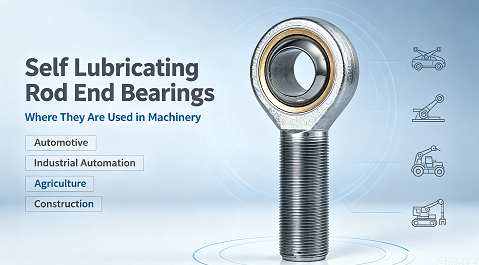
Main Applications of Self Lubricating Rod End Bearings
1. Hydraulic Cylinder Systems
Hydraulic cylinders require components that can handle repeated movement and high loads.
Self lubricating rod end bearings are commonly installed at cylinder ends to connect:
Hydraulic actuators
Control arms
Moving structures
Industrial machinery
Advantages include:
Reduced maintenance
Stable movement
Resistance to vibration
Long operating life
2. Automation Equipment
Modern automation systems require precise and reliable motion control.
Self lubricating rod end bearings are used in:
Robotic mechanisms
Linear motion systems
Assembly equipment
Positioning devices
Their low-friction performance helps maintain accurate mechanical movement.
3. Construction Machinery
Heavy equipment operates under harsh conditions involving:
High loads
Dust
Vibration
Continuous movement
Applications include:
Excavators
Loaders
Cranes
Agricultural machinery
Self lubricating rod end bearings help improve equipment reliability and reduce downtime.
4. Motorsport and Suspension Systems
High-performance vehicles require lightweight and durable linkage components.
Rod end bearings are used in:
Suspension systems
Adjustable control arms
Steering mechanisms
PTFE-lined designs provide smooth movement and excellent response.
Benefits of Self Lubricating Rod End Bearings
Maintenance-Free Operation
The PTFE sliding liner eliminates frequent lubrication requirements, reducing maintenance costs.
Low Friction Performance
The self lubricating structure ensures smooth movement even under continuous oscillation.
Excellent Wear Resistance
High-quality liner materials improve service life in demanding industrial environments.
Suitable for Limited Access Areas
Self lubricating rod end bearings are ideal for applications where regular lubrication is difficult.
How to Choose the Right Self Lubricating Rod End Bearing?
Before selecting a rod end bearing, consider:
| Selection Factor | Description |
|---|---|
| Load Capacity | Choose according to radial and axial loads |
| Thread Type | Select male or female thread based on installation requirements |
| Material | Steel, stainless steel, and composite options |
| Operating Environment | Consider temperature, corrosion, and contamination |
| Movement Frequency | High-frequency applications require wear-resistant designs |
Why Choose Gonuo as Your Rod End Bearing Manufacturer?
Gonuo specializes in manufacturing high-quality rod end bearings for global industrial applications.
The company provides:
Self lubricating rod end bearings
Male and female rod end bearings
Customized specifications
Various material options
OEM manufacturing support
With professional production experience, Gonuo helps customers select suitable rod end bearing solutions for different mechanical systems.
FAQ About Self Lubricating Rod End Bearings
Are self lubricating rod end bearings maintenance free?
Yes. Self lubricating rod end bearings use PTFE or composite liners that reduce the need for external lubrication, making them suitable for long-term operation.
What industries use self lubricating rod end bearings?
They are widely used in hydraulic equipment, automation machinery, construction equipment, agricultural machines, and industrial linkage systems.
What is the difference between normal and self lubricating rod end bearings?
The main difference is the sliding material. Self lubricating rod end bearings use low-friction liners, while standard designs usually require grease lubrication.
CATEGORIES: