


Rod End Bearing vs Spherical Plain Bearing: What Is the Difference?
 Jul 15, 2026|
 View:158
In mechanical systems that require rotational movement, angular adjustment, and load transmission, both rod end bearing and spherical plain bearing are widely used solutions.
Although these two bearing types share similar spherical sliding structures, they serve different purposes in industrial applications. Many engineers and purchasing managers often ask:
What is the difference between a rod end bearing and a spherical plain bearing?
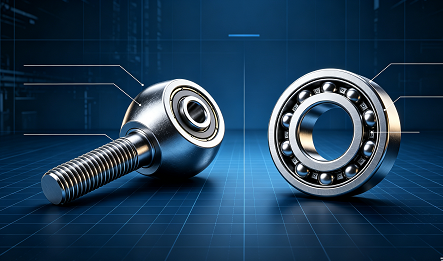
The main difference is that a spherical plain bearing is an independent bearing component designed to accommodate oscillating motion and misalignment, while a rod end bearing combines a spherical plain bearing with a threaded housing, allowing it to connect mechanical components such as rods, shafts, and actuators.
Understanding the differences between these two bearing solutions helps companies select the right product for applications such as automation equipment, hydraulic cylinders, automotive systems, and industrial machinery.
For businesses requiring customized solutions, choosing an experienced rod end bearing supplier is essential to ensure product quality, dimensional accuracy, and long-term performance.
Key Takeaways
A spherical plain bearing is a bearing element designed for angular motion and load support.
A rod end bearing integrates a spherical bearing into a housing with a threaded shank for mechanical connection.
Rod end bearings are commonly used in linkage systems, actuators, and steering mechanisms.
Spherical plain bearings are preferred for heavy-load applications requiring compact bearing arrangements.
An experienced OEM rod end bearing manufacturer can provide customized solutions for different industries.
1. What Is a Rod End Bearing?
A rod end bearing is a mechanical joint component that provides controlled rotational movement between connected parts.
It consists of:
A spherical sliding bearing
An outer housing
A threaded shaft or mounting hole
The unique design allows the bearing to handle angular misalignment while transmitting forces between moving components.
A rod end bearing is commonly used where a mechanical connection needs both:
Rotation capability
Angular movement
Adjustable installation
Typical applications include:
Hydraulic cylinders
Automation equipment
Automotive suspension systems
Agricultural machinery
Robotics
Industrial linkage systems
Unlike traditional bearings, rod end bearings are designed not only to support loads but also to connect moving components together.
2. What Is a Spherical Plain Bearing?
A spherical plain bearing is a type of sliding bearing that allows rotational movement between an inner ring and an outer ring.
The bearing structure usually includes:
| Component | Function |
|---|---|
| Inner ring | Provides spherical sliding surface |
| Outer ring | Holds the inner ring and supports loads |
| Sliding surface | Enables angular movement |
Spherical plain bearings are designed to handle:
Radial loads
Axial loads
Combined loads
Angular misalignment
They are commonly used in applications where components experience oscillating or slow rotational movements.
Typical applications include:
Construction machinery
Heavy equipment
Aerospace systems
Hydraulic equipment
Industrial machines
3. Rod End Bearing vs Spherical Plain Bearing: Main Differences
| Feature | Rod End Bearing | Spherical Plain Bearing |
|---|---|---|
| Basic structure | Spherical bearing with threaded housing | Inner ring and outer ring bearing design |
| Main function | Connect moving components | Support movement and loads |
| Installation | Threaded shaft or mounting hole | Press-fit or mounted into housing |
| Application focus | Linkage systems and actuators | Heavy-duty bearing arrangements |
| Adjustment capability | High installation flexibility | Depends on mounting design |
| Common industries | Automation, automotive, hydraulic systems | Machinery, construction equipment |
4. Difference in Design Structure
Rod End Bearing Design
The biggest feature of a rod end bearing is the integrated rod body.
The threaded shank allows direct connection with:
Control rods
Hydraulic cylinders
Mechanical arms
Linkages
This makes installation easier in systems requiring adjustable connections.
For example, in a hydraulic cylinder assembly, the rod end bearing can connect the cylinder rod with another mechanical component while allowing angular movement.
Spherical Plain Bearing Design
A spherical plain bearing focuses mainly on bearing performance.
It usually needs to be installed into:
Housings
Shafts
Mechanical assemblies
Its design provides excellent load support and misalignment compensation.
Compared with rod end bearings, spherical plain bearings are more suitable when the bearing itself is the primary load-supporting component.
5. Application Comparison
Rod End Bearing Applications
Rod end bearings are widely used in:
Hydraulic Systems
Hydraulic cylinders
Control mechanisms
Valve systems
Automotive Components
Suspension linkage
Steering systems
Racing vehicle components
Industrial Automation
Robots
Motion control systems
Automated machinery
Spherical Plain Bearing Applications
Spherical plain bearings are commonly used in:
Heavy Machinery
Excavators
Cranes
Mining equipment
Industrial Equipment
Gear mechanisms
Rotating assemblies
Mechanical joints
Aerospace Systems
Used where:
High reliability is required
Space is limited
Angular movement exists
6. Load Capacity: Which One Performs Better?
The load capacity depends on the specific bearing design, material, size, and application conditions.
Generally:
Spherical Plain Bearing
Advantages:
Designed for direct load support
Suitable for heavy-duty applications
Handles high radial and axial loads
Rod End Bearing
Advantages:
Provides mechanical connection
Handles combined loads
Allows easy adjustment and installation
For applications requiring maximum load support, engineers often choose spherical plain bearings.
For applications requiring flexible linkage connections, rod end bearings are usually preferred.
7. Self-Lubricating Rod End Bearing vs Standard Bearing
Modern industrial applications increasingly use self-lubricating designs.
A self-lubricating rod end bearing offers:
Reduced maintenance requirements
Lower friction
Longer service intervals
Improved operation reliability
Common materials include:
PTFE liners
Composite materials
Special alloy surfaces
These designs are especially suitable for:
Automation equipment
Outdoor machinery
Applications where regular lubrication is difficult
8. How to Choose Between Rod End Bearing and Spherical Plain Bearing?
The correct choice depends on several factors.
Choose a Rod End Bearing When:
A threaded connection is required
Mechanical linkage adjustment is needed
The application involves actuators or control rods
Easy installation is important
Choose a Spherical Plain Bearing When:
High load capacity is required
The bearing is mounted inside a housing
Heavy machinery applications are involved
Long service life is needed
9. How to Choose a Reliable Rod End Bearing Supplier?
Selecting the right rod end bearing supplier is important for manufacturers and industrial buyers.
Key factors include:
Manufacturing Capability
A professional supplier should have:
Precision machining capability
Quality inspection processes
Stable production capacity
Product Range
A reliable supplier should provide:
Male rod end bearings
Female rod end bearings
Spherical rod end bearings
Self-lubricating rod end bearings
Customization Service
Many industries require:
Special dimensions
Custom threads
Different materials
OEM packaging
Working with an experienced OEM rod end bearing manufacturer allows companies to develop products that match specific application requirements.
10. Why Choose Gonuo as Your OEM Rod End Bearing Partner?
Gonuo Bearing specializes in manufacturing rod end bearings and related mechanical connection solutions for global industrial applications.
The company provides:
Standard rod end bearing series
Customized OEM rod end bearing solutions
Different material options
Industrial application support
With manufacturing experience and product customization capabilities, Gonuo helps customers in industries including:
Automotive
Industrial automation
Agricultural machinery
Hydraulic equipment
For companies searching for a reliable rod end bearing supplier, customized production capability and consistent quality control are key factors when selecting a long-term partner.
FAQ
1. What is the main difference between a rod end bearing and a spherical plain bearing?
A rod end bearing includes a spherical bearing combined with a threaded housing for mechanical connection, while a spherical plain bearing is mainly used as a standalone bearing component.
2. Are rod end bearings and spherical plain bearings interchangeable?
Not always. The correct choice depends on installation requirements, load conditions, and mechanical design.
3. What industries use rod end bearings?
Rod end bearings are commonly used in automotive systems, hydraulic cylinders, automation equipment, and industrial machinery.
4. What is an OEM rod end bearing?
An OEM rod end bearing is a customized bearing solution produced according to a customer's specifications, including dimensions, materials, threads, and performance requirements.
5. How do I choose a rod end bearing supplier?
Choose a supplier with manufacturing experience, quality control systems, customization capability, and a proven ability to support industrial applications.
Conclusion
Both rod end bearing and spherical plain bearing play important roles in modern mechanical systems, but they serve different purposes.
A spherical plain bearing focuses on supporting loads and accommodating angular movement, while a rod end bearing provides a complete connection solution for moving mechanical components.
For applications requiring flexible installation, linkage control, and customized solutions, selecting a professional rod end bearing supplier with OEM rod end bearing capabilities can help ensure reliable performance and long-term value.
Gonuo Bearing provides customized bearing solutions designed to meet the needs of global industrial equipment manufacturers.
Tags:
CATEGORIES:
